
Domain’s analysis of previous housing cycles shows the country is now entering another downturn.
These findings align with recent data pointing to a marked cooling in market conditions, with Cotality reporting in its latest Home Value Index (HVI) that the peak has passed in March.
While prices are now easing, Domain’s FY2027 Forecast Report noted every completed downturn since the mid-1990s was followed by a recovery that exceeded the preceding decline.
The report found Australia’s eight completed downturns produced an average peak-to-trough decline of 2.9% over about eight months.
“What is striking is not the downturns themselves, it is how contained they were,” the report stated.
In every case, the decline stayed below 8%, with the annual fall in 1995 (the first downturn in the 30-year span) barely reaching -1%, while the deepest decline was -7.1% in 2019.
“Downturns can feel sharp in real time, but historically they’ve been short and shallow, and have not unwound the gains that preceded them,” Domain chief residential economist Dr Nicola Powell said.
The report found subsequent upswings since 1995 delivered average gains of 32.3% over a much longer period, 2.8 years.
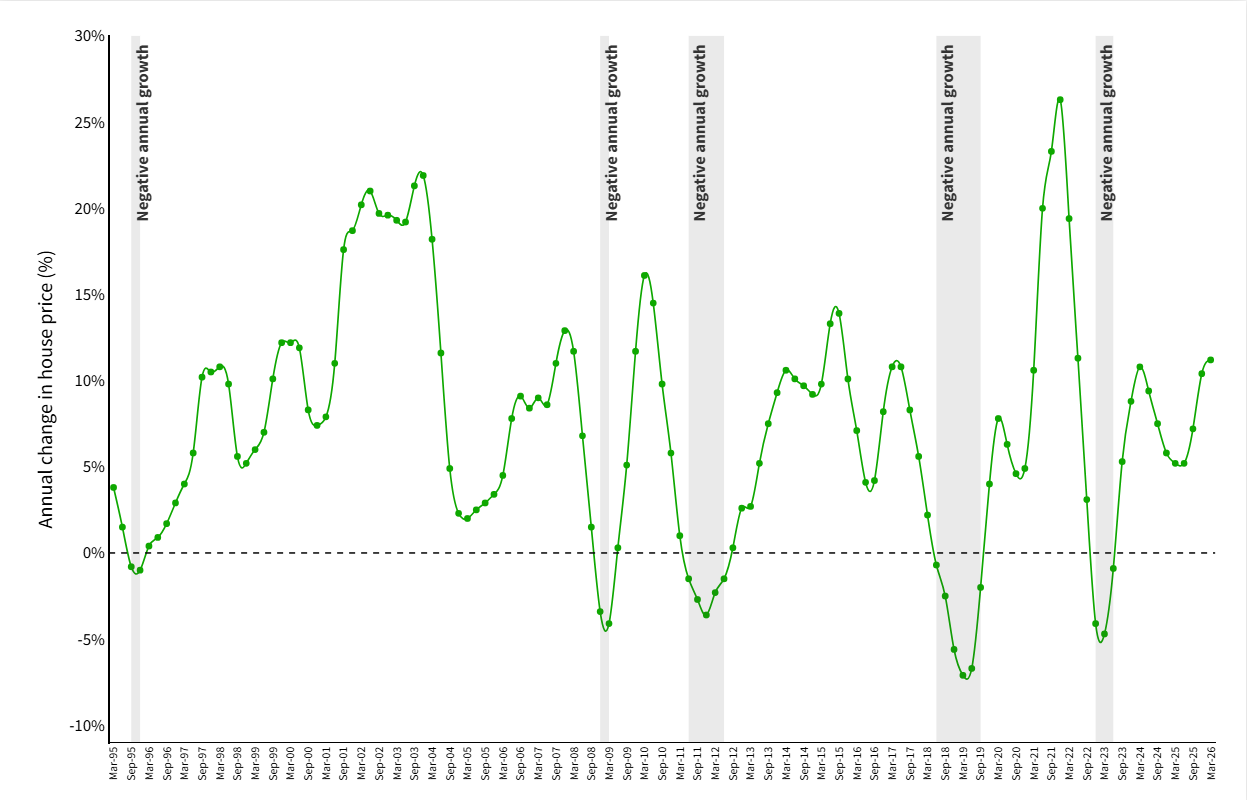
Source: Domain FY2027 Forecast Report
Per Domain, upswings outpacing downturns in duration and magnitude have followed every completed cycle but the one we’re currently in.
Sydney and Melbourne lead housing slowdown
Domain forecasts house prices will fall in FY2027 by as much as 7% in Sydney and a sharper 8% in Melbourne.
“Sydney and Melbourne are leading the shift – recording quarterly declines and bearing the full weight of three RBA rate hikes in the first half of 2026,” Domain said.
For combined capitals, the decline is forecast to hit 0.5%.
Sydney and Melbourne have historically led downturns, and recent data shows history repeating itself.
The latest HVI reveals Sydney home values are now down 3.2% over the June quarter, while Melbourne has slipped 2.6%.
Melbourne is considered particularly exposed as it entered the downturn with a smaller buffer from recent gains compared to other capitals.
Domain’s analysis shows the Victorian capital only recorded a 7% gain in 1.25 years.
By comparison, Sydney’s recent upswing resulted in 24.5% growth in three years.
“[Melbourne] needed to fall only 6% to reach its previous trough at the start of this downturn,” the report read.
Perth and Brisbane continue to diverge
Unlike Sydney and Melbourne, Brisbane and Perth are forecast to continue recording price growth in FY2027..
Domain forecasts Brisbane house prices will rise between 3% and 7%, while Perth is expected to record growth of between 5% and 9%.
Supporting the forecast gains in the two mid-sized capitals are population growth, housing supply constraints, and tight rental markets.
See also: Perth property market: Where's it heading?
From their most recent troughs, Brisbane house prices climbed 63.4%, while Perth surged 77.6%, according to Domain's analysis.
The findings come as fresh housing supply remains constrained.
Latest ABS building approvals data showed total dwelling approvals fell 1.1% in May to 17,019.
Driving the decline was the 10.4% fall in total private dwellings excluding houses, effectively unwinding the 4% rise in April.
What could shape Australia’s ninth housing downturn
The timing of any shift in monetary policy is likely to be closely watched by the market, with interest-rate cycles turning historically acting as the catalyst of each recovery.
Domain forecasts the cash rate has peaked at 4.35%, with the first cut to be delivered in June quarter 2027.
“When the interest rate cycle turns, demand that has been sitting on the sidelines tends to return quickly, bringing the next phase of growth forward,” Dr Powell said.
Conversely, Domain said a delay in rate cuts or additional tightening would place further pressure on borrowing capacity and could push price outcomes towards the lower end of forecast ranges.
Beyond interest rates, the report also highlighted proposed changes to negative gearing and capital gains tax arrangements as sources of uncertainty.
See also: Budget reforms drive Aussie investors to rethink property exposure
Ultimately, Dr Powell argued, “while there’s heightened focus on government policy, housing cycles have consistently been driven by interest rates, borrowing capacity and confidence.”
Image by Hugo Heimendinger on Pexels