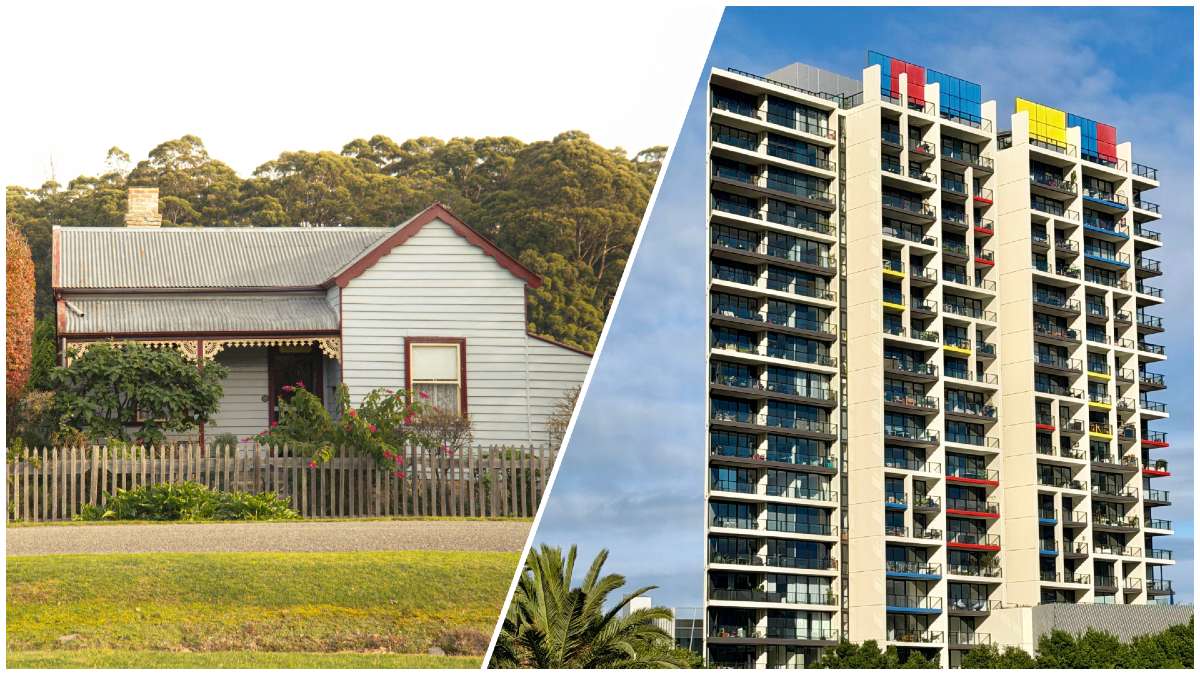
Domain's 'Matching Demand Report', published Thursday, found affordability pressures are increasingly influencing not just where Australians buy but also what they buy.
The report compares buyer price searches against actual property listings.
Despite a moderation in price growth, it found listings continue to exceed buyer budgets in most house markets.
Detached houses remain beyond what buyers can afford in every capital city, with the largest affordability gap recorded in Canberra where inner-city house listings exceeded search budgets by $538,000.
In Melbourne, the inner-city affordability gap stands at $440,000, while it's $400,000 in Sydney.
"The housing market has cooled, but affordability hasn't improved enough to bring detached housing back within reach for many Australians," Domain chief residential economist Dr Nicola Powell said.
Houses remain out of reach across capital cities
The Domain report found that in many cities, the affordability gap between detached houses and medium-density housing is now greater than the difference between inner and outer suburbs.
Instead of moving further from the CBD "in pursuit of affordability", many buyers are instead adjusting their dwelling preferences.
"For decades, affordability pressures pushed buyers further from the CBD," Dr Powell said.
"Today, many are making a different trade-off, changing the type of home they buy rather than where they buy."
Price difference between listing and buyer searches, inner-city houses
|
City |
Search prices |
Listing prices |
Gap |
|
Sydney |
$2,500,000 |
$2,900,000 |
-$400,000 |
|
Melbourne |
$1,100,000 |
$1,540,000 |
-$440,000 |
|
Brisbane |
$1,300,000 |
$1,650,000 |
-$350,000 |
|
Adelaide |
$950,000 |
$1,160,000 |
-$205,000 |
|
Perth |
$950,000 |
$1,140,000 |
-$190,000 |
|
Canberra |
$1,200,000 |
$1,740,000 |
-$538,000 |
|
Hobart |
$800,000 |
$835,000 |
-$35,000 |
|
Darwin |
$750,000 |
$1,000,000 |
-$250,000 |
Source: Domain Matching Demand Report
Medium-density housing becomes the affordability bridge
As buyers ditch detached housing due to affordability constraints, townhouses and apartments showed the closest alignment between buyer budgets and listing prices.
Dr Powell said "the biggest divide in Australia's housing market is no longer simply between inner and outer suburbs".
"Townhouses and apartments [are] emerging as the point where buyer demand and available supply are most closely aligned."
Domain described townhouses as the "middle ground between aspiration and affordability", offering buyers more space than an apartment without the price premium typically associated with a detached home.
Sydney offered one of the clearest examples of the shift.
The city's inner-ring townhouse market swung from a $200,000 seller premium a year ago to a $100,000 buyer premium in 2026 as buyer demand strengthened relative to listings.
Several townhouse markets, particularly in Adelaide and parts of Brisbane and Canberra, were operating closer to balance or in buyer-favourable territory.
Price difference between listing and buyer searches, inner-city townhouses
|
City |
Search prices |
Listing prices |
Gap |
|
Sydney |
$1,900,000 |
$1,800,000 |
$100,000 |
|
Melbourne |
$950,000 |
$1,100,000 |
-$150,000 |
|
Brisbane |
$1,000,000 |
$1,050,000 |
-$45,000 |
|
Adelaide |
$850,000 |
$820,000 |
$30,000 |
|
Perth |
$850,000 |
$925,000 |
-$75,000 |
|
Canberra |
$900,000 |
$1,300,000 |
-$400,000 |
|
Hobart |
$700,000 |
$790,000 |
-$90,000 |
Source: Domain Matching Demand Report
Units emerge as the market's sweet spot
Apartments recorded the strongest alignment between buyers and sellers of any housing type, with buyer search prices matching or exceeding listing prices across many markets.
Buyer premiums were particularly evident in Canberra, Hobart, Adelaide and Darwin, where buyers were often searching above prevailing listing prices.
According to Domain, this may indicate buyers are prepared to spend more on better-quality or better-located apartments than the stock currently available.
Hobart recorded some of the strongest buyer-led conditions, with middle-ring unit buyers searching up to $166,000 above listing prices.
Canberra's middle-ring unit market also recorded a buyer premium of $120,000.
Price difference between listing and buyer searches, inner-city units
|
City |
Search prices |
Listing prices |
Gap |
|
Sydney |
$950,000 |
$1,000,000 |
-$50,000 |
|
Melbourne |
$600,000 |
$603,000 |
-$3,000 |
|
Brisbane |
$800,000 |
$800,000 |
$0 |
|
Adelaide |
$650,000 |
$600,000 |
$50,000 |
|
Perth |
$700,000 |
$649,000 |
$51,000 |
|
Canberra |
$650,000 |
$620,000 |
$30,000 |
|
Hobart |
$700,000 |
$572,000 |
$128,000 |
|
Darwin |
$550,000 |
$510,000 |
$40,000 |
Source: Domain Matching Demand Report
The findings come as recent data revealed units are among the first segments to feel the impact of the housing downturn.
See also: Housing downturn hits units first
Recent resale data showed units in Sydney and Melbourne are bearing the brunt of declining profits as market conditions soften.
Affordability shapes housing choice
The report findings point to a market increasingly characterised by substitution rather than geographic trade-offs.
Many buyers appear to be remaining close to employment hubs, transport links and lifestyle amenities by opting for townhouses and apartments instead of detached houses.
But Dr Powell said this doesn't mean buyers are completely "abandoning" houses for townhouses or units.
"Rather, it shows that the stock most closely aligned with contemporary buyer budgets is increasingly concentrated in medium-density housing."
Images by Anh Thu Le and Joolmagools from Pexels