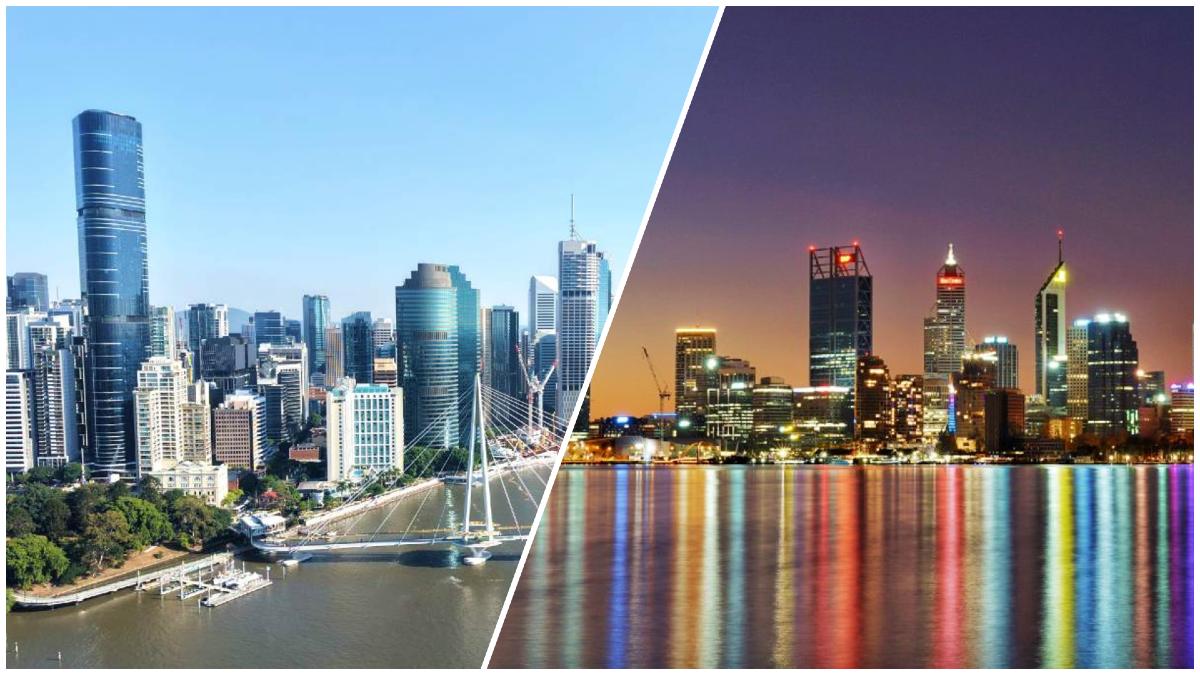
A new Cotality report published on Wednesday revealed Perth and Brisbane are experiencing their fastest downturns on record amid the current market correction.
As at end of October, Perth values had fallen 8.9% from the city's peak while Brisbane took an 8.3% dive, the second and third largest falls respectively after Sydney (-10.1%).
See also: Perth's rental market heats up as property prices cool
Fellow post-COVID investor hotspot Adelaide has also cooled, albeit at a slower pace, down 4.4%.
The combined capital city market has fallen 8.1% over seven consecutive months, marking the fastest decline in more than 40 years.
Mid-sized capitals lead the second phase of downturn
Cotality head of research Gerard Burg noted the decline seen in mid-sized capitals marked the second phase of the downturn, with the initial phase led by large capitals.
"Melbourne and Sydney led the early stages of the downturn, peaking in November 2025 and February 2026 respectively," Mr Burg said.
Melbourne values have fallen 7.8% since their peak and Sydney is down 10.1%.
But Perth's -8.9% and Brisbane's -8.3% falls have cemented them as the second and third worst-performing capital city markets in the current downturn.
"[Perth and Brisbane] are now experiencing their fastest downturn on record," Mr Burg said.
He added that the former boom markets had become the new weak spots as stretched affordability collided with higher borrowing costs.
"Strong growth in home values in these markets post-COVID substantially stretched affordability metrics, increasing the demand-side pressures associated with rate hikes this year," Mr Burg explained.
After the November meeting, the RBA has now raised the cash rate five times this year, bringing it to its highest level in 18 years at 4.85%.
See also: What a 4.85% cash rate means for investors
Buyers disappearing from the market
Cotality's monthly chart pack shows national sales volumes have fallen for 10 consecutive months.
The traditionally busy spring selling season failed to materialise, with roughly 116,000 properties changing hands over the three months to October, 18% below the five-year average.
The retreat has been especially pronounced in Perth and Brisbane, where annual sales volumes have dropped 21.4% and 17.8% respectively
Canberra (+8.9%) and Hobart (+0.8%) were the only capitals where sales volumes rose.
Compounding the problem for sellers is a growing mismatch between supply and demand.
New listings coming to market reached 38,207 over the four weeks ending 8 November, 13.9% fewer than the year prior, while total listings continue to rise 18.6% at 155,055.
The divergence between new and total listings is most evident in Brisbane, where new listings were down 12.4% over the year, but total listings have surged 59.5%.
See also: Listings pile up as sellers lose leverage
Sellers losing bargaining power
Conditions in the mid-sized capitals are increasingly tilting in buyers' favour as seen in the increase in vendor discounting.
Brisbane and Perth vendors are accepting median reductions of 5.6% and 5.3% respectively from their original asking prices as the pool of active buyers has shrunk.
National median vendor discounts widened to 4.5% over the year, the highest level since mid-2019.
Sellers are becoming increasingly willing to negotiate on price as properties take longer to sell.
According to Cotality, the national median time on market reached 41 days in the three months to October, up from 24 days a year earlier and highest level since 2020.
Across the capitals, the figure has risen to 39 days while regional markets have stretched to 45 days.
Perth and Hobart are the quickest to sell at 28 days, though Perth's median days on market more than tripled over the year.
Property recovery could be a long way off
Mr Burg said a sustained recovery may still be some distance away, as buyer confidence remains subdued and borrowing power remains constrained.
"A recovery in housing market conditions is unlikely until buyers have the confidence and financial capacity to return to the market," he said.
While housing markets have cooled rapidly this year, the factors that drove the correction - higher borrowing costs, weakened affordability and tighter investor conditions - remain firmly in place.
The RBA Board's November decision to lift the cash rate to 4.85% has pushed borrowing costs even higher.
Average variable mortgage rates have climbed to 6.22% for owner-occupiers and 6.41% for investors in September.
"Rates are likely to move higher again once the previous cash rate hikes are fully passed on," Mr Burg said.
Recent changes surrounding negative gearing and CGT have also markedly affected investor appetite.
See also: What investor should know about the negative gearing changes
Looking ahead, Mr Burg believes lower interest rates will ultimately be needed to restore confidence and improve affordability.
"Affordability and investor policies are likely to remain constraints, meaning it is likely that rate cuts from the Reserve Bank will be necessary, which currently appears unlikely before the second half of 2027."
Image from Pexels
